
February 15, 2026
When someone asks me what I do, I reply “I help prevent and heal math trauma to give students a shot at passing their math classes, finishing college, and succeeding in life.”
Generally, their intrigue is accompanied by the comment that they have or know someone with math anxiety. I get why people say this.
I’ve seen some talk about math anxiety and equate it with math trauma. I completely disagree. Math anxiety and math trauma are not the same. Math anxiety is only one part of math trauma.
A person can be traumatized by math and not have math anxiety. A person can also have math anxiety, but it doesn’t rise to the level of trauma. What’s the difference between math anxiety and math trauma? We’ll explore that now.
What is math anxiety?
Like other forms of anxieties, math anxiety is a fear that is triggered when a specific action is happening. In this case, math anxiety is the fear of doing math.
When a person has math anxiety, their hands may tremble. Their palms may sweat. Their adrenaline may rise. These are all signs that a fear response is being triggered in a person.
Fear is a natural human response that may or may not be chronic or debilitating. In other words, fear doesn’t have to be constant or cripple us.
Back before apps, when I went out to dinner with friends, they’d ask me to split the check. They figured that because I’m a mathematician, I could do it correctly with no issues. That made me nervous because I was afraid that I would mess up and embarrass myself.
My math anxiety was triggered. But that anxiety didn’t last; it was in the moment. In this case because the stakes are high, my anxiety may have helped me. When my heart is beating a little faster, more blood is rushing to my brain. When my pupils are dilated, my eyesight may be a little clearer.
This is only an issue if the fear or anxiety gets out of hand and is too much to handle. Then we have a problem. If, like other anxieties, your math anxiety is debilitating and getting in the way of you being able to navigate in your life, then you have a problem. That’s when you need help.
Math trauma is probably confused with math anxiety because math anxiety was the first socio-emotional factor recognized to affect people’s ability to do math.
Math anxiety was first discussed in education in the 1950s and it’s been well studied since.
However we still don’t have a clear answer to how to help reduce math anxiety in all circumstances.
I think the reason why math trauma and math anxiety are so often confused is because other forms of math trauma are showing up as anxiety when there’s really more beneath the surface. As a result, it’s easy to think that all personal or emotional issues with math are a type of math anxiety.
Frankly, our understanding has come a long way, making the picture more complicated and thinking math trauma and math anxiety are the same thing makes helping people harder (and solutions less effective).
Defining math trauma and its ties to dehumanization and shame
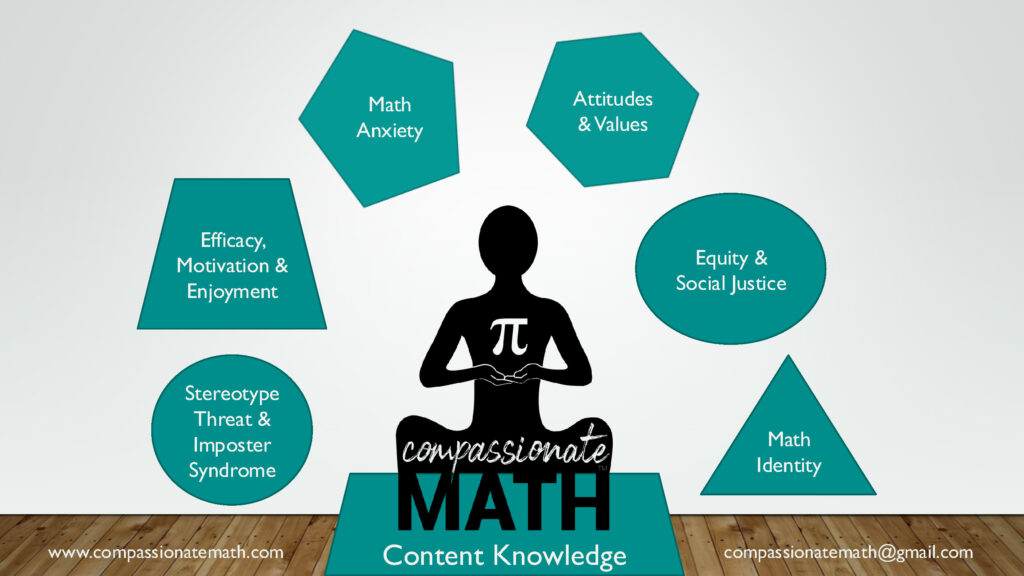
So, what is math trauma exactly? Math trauma, unlike math anxiety, is the effect of previous negative experiences which result in the inability or unwillingness to engage in mathematics in the present.
Math trauma is more than just anxiety, it can include feelings of imposter syndrome (I’m a faker and will be found out), identity (I’m not a math person), self-efficacy (confidence that I’ll be successful), and more. Although these feelings can be similar, they are quite different.
In the picture above, the Compassionate Math Framework outlines the full scope of how math trauma is manifested or seen.
The Compassionate Math Framework sits atop “content” because that’s ultimately the goal, to be able to engage in rich mathematics in a way that is natural and feels good. The rest of the bubbles are the socio-emotional factors that contribute to mathematical success, the different ways our emotions get in the way of our math learning and although math anxiety may be the most common, it’s not the only “negative feeling” associated with math.
Math trauma results from feeling dehumanized as a mathematical being. Dehumanization occurs when your inherent value as a mathematical being is not recognized.
In other words, a person’s value should be tied to their existence; being human makes you inherently valuable. When your value is only tied to what you can provide for others, then you are being dehumanized.
Do we see this in math? Unfortunately, yes.
Students are too often made to feel that their worth is tied to how well they do in math, their scores, and whether the answer (and not the process) is correct.
Take a student who makes a small mistake and gets the wrong answer on a problem. Then they apply their wrong answer correctly on the second part of the problem. The dehumanization occurs when the second part of the problem is marked completely wrong. The effort and contribution the student made in solving the second problem perfectly didn’t matter because they started with an incorrect result from the first part.
We don’t do this to criminals, that’s called double jeopardy and it’s illegal. But we do this to math students all the time. Compare that to how someone would feel if their worth were tied to how hard they worked, how far they’ve come, or how creatively they solved a problem. That is the difference between valuing someone for their existence (their inherent value) vs valuing someone for what they provide (ignoring inherent value).
Think about it this way. If the worth of the mathematical part of ourselves is only tied to how good we perform on a test, then we’re no different than a remote control whose worth is only tied to whether it lets you control your TV without getting up. This means that when the remote stops working we throw it away, what about people who don’t do well in math, what happens to them?
Being treated like your worthiness is based on how well you do on an exam or a homework assignment, and not about your ideas or how you grow or think mathematically is the critical component to math trauma.
This feeling of dehumanization may lead you to feel that math is somehow not a part of you and is out of your reach. That is the dehumanization that is tied to having math trauma. Why is this feeling dehumanizing?
Because human beings are mathematical beings. You are human and therefore you are a mathematical being.
Math trauma is the result of being dehumanized when learning math (whether that’s in class, school in general, or at home working on homework). Math is a natural, human endeavour that helps us understand and control our world.
When we are made to feel that math isn’t for us, or that math isn’t relevant in our world, we are being denied a natural part of us, this is what dehumanization is.
When we are told that we’re only worthy if we do well on tests, and not given opportunities to explore and wonder, then we’re being denied our humanity.
Math trauma is also tied to feelings of shame related to math. Yes shame, feeling unable to or unworthy of learning math. Dr. Brene Brown says that shame is an unhelpful and destructive emotion. The shame of not learning math leads down so many dead ends.
- Math trauma is what makes someone choose their college major based on the math requirements (avoiding something they’re interested in because of the necessary math and compromising their future).
- Math trauma is what makes someone not apply for a promotion because they will have to handle budgets and projections (giving up more professional prestige and money).
- Math trauma is part of why people avoid dealing with their finances and I suspect math trauma is a reason so many new businesses fail (you need to leverage the power of numbers to do both).
Healing our math trauma and how we are seen in society
In my experience those who have experienced math trauma are often those who have been considered less human by others.
In other words, the more human someone thinks I am, the more mathematically they treat me. The less human someone thinks I am, the less mathematical they will treat me (as a BIPOC woman, I’ve seen this in action).
Yes, our math traumas are strongly tied to our identities (gender / sexual identification and preference, race, ability, class, etc.). To work through math trauma, we must recognize our place in the world and how math can be used as a gate keeper.
How math may have been used to keep us down. How those who taught us math may have been victims of the same system; I call this the Cycle of Benign Neglect. What is math trauma? It’s a wounding of our core humanity.
If you feel that you have math trauma, the key to remember is that you don’t need someone to wave their magic wand, give you a made-up certificate, and say you’re healed after reading a book or attending a workshop (even mine!).
What I try to do is help people tap into their own power, human dignity, and recognition of their own human worth; to me that is the key to healing one’s math trauma. That’s the work I’m trying to do.
Seeing this everywhere
My journey as a mathematician and as an educator is tied to my experiences in the field and it is a driving force behind the work that I do.
Far too many of us, including myself, suffer or have suffered from math trauma. It was only when I studied mathematics professionally that I started to experience my own math trauma. After a while, I couldn’t ignore what I was seeing and experiencing, especially in the classroom. I saw too many students who wrote off their own potential because of an experience they had and a story they were made to believe.
It’s time to change how we all think about and engage with math because at this point in human history, it’s critical for our survival.
©2026 Compassionate Math, LLC. All rights reserved.
This material is original content and was not created using AI (except for standard spelling and grammar checkers).