
September 15, 2026
Last month, I launched my book, Compassionate Math: Book One in the Compassionate Math Series. To celebrate, I invited my friends, family, and colleagues to celebrate at the Maritime Aquarium in Norwalk, CT.
Great food, great company, and a great space made for a wonderful and memorable night (the dress didn’t hurt either!).
Like every book launch, I read from my book. First, I started by telling the story of the book and with it, the story of Compassionate Math. The story of how I came to doing this work.
Here’s that speech, and that story…
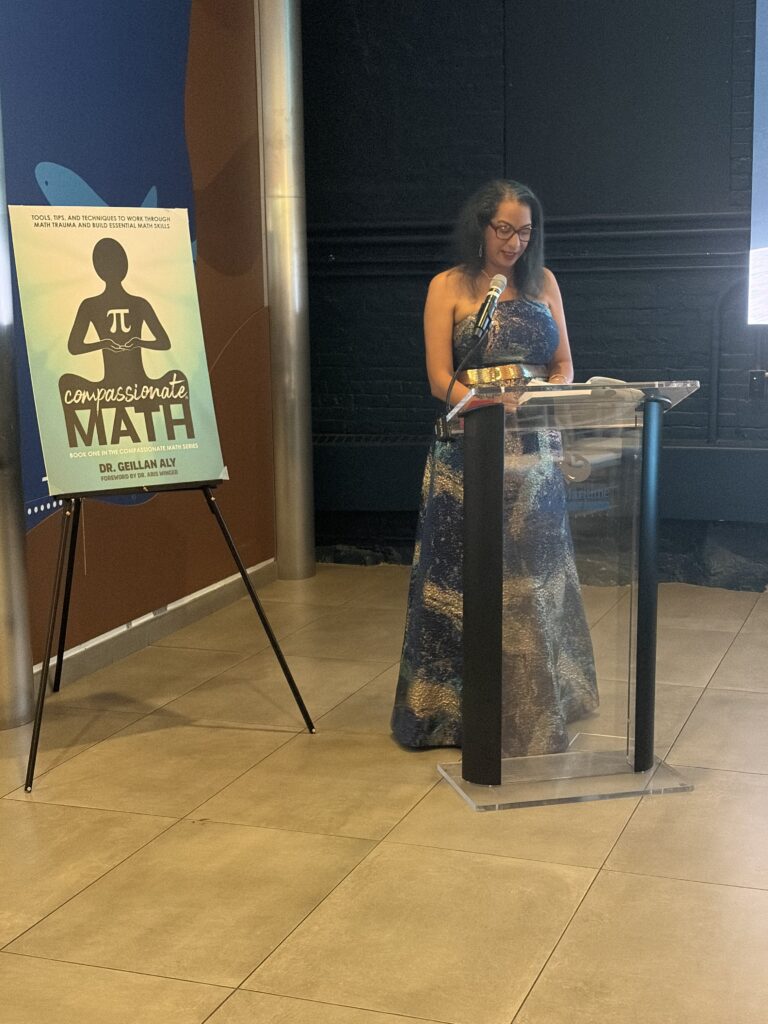
Photo credit: Alexis Greene
I want to take you back to five years ago, when I was really frustrated.
I had taken a leave of absence from my institution, as I was being encouraged to apply for tenure (a job for life), because as I say, “I had a fundamental disagreement with them over how brown people with vaginas are treated.”
Some of that frustration was due to a difference of opinion about our students’ intelligence and potential. Hearing those words from my colleagues I would always think “There but for the grace of God go I.”
Those remarks reminded me a lot about how some faculty spoke to me and about me, except this time I was on a different side of the conversation.
My Own Math Trauma
See, I didn’t have the easiest time in graduate school.
In fact, I was told several times that I wasn’t cut out for mathematics. The problem was this.
I wasn’t the only person who had a hard time in graduate school. A lot of people did. The difference was that some of us got the benefit of the doubt, while some of us didn’t. I certainly wasn’t in the top of my class, and wasn’t acing everything, but I absolutely jumped through all the hoops that lay before me.
And I got my PhD. I got my PhD because there were faculty who told me I had talent; that I was bright, and that they would support me, but I carried my own math trauma for several years.
One thing I want to highlight in my story is the idea of perspective and the equity and power dynamics surrounding them.
I have a hard time telling my story because it sounds like I’m whining.
“Oh, she failed her quals…” which I didn’t, “and is now crying math trauma”.
“She couldn’t cut it in math and now is doing this work to make herself feel better.”
“Objectivity” gets assigned to those in power, even in subjective cases.
What I heard and what I saw, among me and so many others in different years, across different departments, and all around the country showed the patterns clearly. But we’re still told that there’s no issue with racism because we treated everyone equally.
“She was well liked so there’s no racism there.”
Imposing your subjectivity onto my subjectivity is a social justice issue.
Honestly when it comes to someone’s experience there is no objectivity, only nuance and perspective.
Teaching and Learning Math
Another frustration came from math education in general.
I was frustrated with how math was being taught and how we talked about math, what math is, and who can do math.
I taught developmental math, which means math in college, that isn’t at the college level. A lot of that content was dry and condescending, and although I absolutely tried to do right by my students, I started to see how I could do more.
I envisioned a different way to think about and teach math so that it was meaningful to our students.
During my leave, I started to really reflect on my experiences as a math learner and math professor.
The pieces started to fall together over how people make assumptions over intelligence and presume that everyone had the same quality of life and of education they did.
I did the only thing I could do when I’m confused and frustrated and passionate. I started to write. Just to get it out. I needed to write so I could sort out my feelings.
The Birth of Compassionate Math
There was one day, where I spent the entire day outlining, writing, and sorting my thoughts. I wasn’t sure what I was writing, but I needed to get it down.
The next day, I started reading what I wrote to see how I could pull myself out of the mess I was feeling.
Reading and reflecting on my writing, I wanted to know where to take this. I saw something moving above me. I looked up and the words “Compassionate Math” were above me; the letters turned into gold sprinkles and showered me and warmed me.
I sat there for a minute, then grabbed my laptop and brought the domain compassionatemath.com and reserved the email address compassionatemath@gmail.com.
What I was going to do with it? I had no idea. But I started jotting down some ideas and recorded the Compassionate Math framework and the basic tenets of Compassionate Math, that Human Beings are Mathematical Beings and that learning math is both an emotional and cognitive endeavor. I was writing more.
When I started talking about Compassionate Math as a way to help teachers and students, I got great feedback. Some of the most important was from Lori Thulen.
She was concerned that PD focused on math content could sound like I didn’t believe teachers understand math and has a deficit perspective.
That was far from the truth, and I started to outline something I learned in Graduate School and took for granted. I called it the Cycle of Benign Neglect which states that since WWII math curriculum has swung back and forth like a pendulum from either conceptual to procedural math. As a result, we get these generational disconnects in how people think about math. So a parent or teacher understands math one way and a student is learning it another.
I wanted PD to be a bridge between the divide. Turns out that a pattern I saw in graduate school was not documented as an explanatory model in education; I just saw that in the work I read.
What I took for granted was a contribution to the field, so I started writing it up.
Getting Off the Ground
In those few days, there was another important moment that completely shifted my destiny. I called Eileen Murray. She wasn’t the only person I talked to during this time, but in our conversation as I was telling her how lost I was and how I had no idea what to do, she advised me to go help teachers.
“Nope! Teachers scare me.”
“Geillan, it’s the first semester back from the pandemic and teachers are struggling. Go help teachers.”
She wasn’t the first person to say this to me. During my qualifying exams, Jessica Summers who was on my doctoral committee, asked me why my research is focused on helping students, rather than teachers since I talked like a teacher educator.
I gave Eileen the same answer I gave Jessica. “I’ve never been in a K-12 classroom extensively; teachers hate when the professor comes over from the ivory tower and tells them what’s what. I didn’t want to disrespect them like that.”
“Shut up and go help teachers.”
She followed up. She connected me with Chandra Orill, who got me my first job at Argosy Collegiate Preparatory School.
I was petrified. I had no idea what to do or say. I absolutely didn’t want to offend these teachers since their job is hard enough.
I didn’t know how to do PD, so I did the only thing I could, I went in as a researcher, leading with curiosity (which is how I generally approach PD).
I observed their classes. I looked at their plans. I watched their students and their responses to the content and how it was presented.
Afterwards, I met with the teachers. I asked them why they made the moves they did.
I asked them about their classroom practices.
I asked him why they corrected certain students the way they did.
The conversation was intense and enlightening. I didn’t go in with preconceived notions, and I started off by saying, that I am humbled by their presence and that my goal is to help them and see if any of my experiences and skills can support them (which is often how I start when I do PD with teachers who are strangers).
A lot of the struggles they had in the classroom was due to fallout from the pandemic.
The issues I saw with their teaching had nothing to do with their skillset, or their dedication, or any of the nonsense that’s spouted over teachers.
The students were traumatized by COVID and the teachers responded in the only way they knew how.
The problem was that their response didn’t produce an outcome that satisfied them or the students.
When I walked into that meeting, the teachers were excited that there was someone with new ideas because they were at a loss at what to do. They were stuck.
I left them that day by sharing some ideas, a framework to consider, and a question to reflect on “who is doing the math in your class? You, or your students?”.
I went home that night and my husband asked me how it went. “I found my life’s calling” was my response.
Next month I went back to Argosy and when I walked in, one of the teachers said, “YAY, It’s PD Day!” Not something you ever hear from teachers.
They told me all the amazing ideas they implemented based on our conversation and how their classrooms felt like they changed overnight. The conversation was so exciting!
That collaboration went on over a year until they hired their own dedicated math coach. Argosy helped me see what Eileen and Jessica did.
Math Trauma: The Workshop
Another pivotal moment happened a few months later. My advisor Marcy Wood connected me to a TRiO program for preservice teachers.
TRiO is a program through the Department of Education, God rest its soul, that supports underprivileged students to go to and succeed in college.
This program’s goal was to help make students who wanted to be teachers be successful. These students come from backgrounds where they know how education is liberation and wanted to continue to cycle of liberation. They were dedicated and they were passionate.
But they were also PETRIFIED of their math requirements. The director of this program said that the students were all in on college and being teachers but were so afraid of their math classes because of experiences they had learning math before college and about the reputation of the department (it was a department I knew well and their fears weren’t unfounded at all).
The director shared the students’ stories and without thinking the words “Sounds like they have math trauma” burst out of my mouth. I was asked if there was a way to help the students with it. Of course I said yes.
Now, let me be clear, I didn’t make up the term “math trauma”. Others have used this word.
Months before I had seen a webinar by the educator Dr. Kasi Allen who outlined ideas around math trauma. Although our thinking about the phenomenon was very similar, as I outlined my ideas and framework to prep for these students, there were some seriously stark differences.
I wrote a workshop called “A new day: Working Through Mathematical Traumas”.
It was a love letter to my past self in graduate school. It was me speaking to my past and future students. It was all my ideas coming together.
I designed it for the TRiO students I was heading out to see so I knew I needed to arm them so they can face hostile faculty in math class.
The workshop had 4 stages. Understand the source of your trauma. Know that your experiences learning math had nothing to do with how smart you are but are based on your circumstances and the institutions around you. That as a human being we are all capable of learning math and sometimes that learning doesn’t go well, and sometimes people work hard to prevent you from learning.
Next stage is to forgive. Because you cannot move forward unless you forgive.
Third stage is motivation to set your goals because if you have a north star and you’re focused on it, you’ll see how math fits in your life and keeps you resilient.
Finally, it’s empower. Look at math content and learn strategies to be successful in math.
If you look at the table of contents of the book, you may notice a pattern.
These 4 stages were for me a picture of how to help someone work through significant emotional pain from studying math.
But you can’t just make up nonsense, no matter what people on the internet say.
So I went into the literature again and saw that my ideas weren’t entirely crazy. In fact there is a similar theoretical framework in the area of collective healing in the field of genocide studies.
The framework I saw applied to the defining basis for what I was outlining, that the dehumanization we suffer in math class leads to a collective trauma. This helped strengthen my ideas and my workshop.
The day I presented the workshop; I was a nervous mess. I didn’t want to do more harm to the students, and I didn’t want to get this wrong.
I mean using my own experiences and work in the area of genocide seems INSANE. No one is doing work like this. No one is working with teachers like this. What was I thinking? I don’t know.
But as they say, the show must go on.
A New Day
About 30 minutes into this workshop, the energy was intense. The collective mood had shifted.
I remember that moment, the students were sharing their experiences, and I blurted out “my professor told me I wasn’t intelligent enough to get a PhD”. The mood shifted.
I was one of them, but I was on the other side and was giving them a way forward.
By the end of the workshop, there was a room of students, fully animated and engaging with the math problem I gave them.
The TRiO director walked right up to me afterwards and said, “so what are you doing next year?”.
Afterwards, I heard stories from that director and the chair of the department that my workshop continued to resonate throughout the semester and year.
From there, Compassionate Math has grown.
I’ve worked with just about 50 institutions and programs, several for multiple years. I’ve delivered my math trauma workshop to hundreds of students.
I’ve also provided PD to teachers and university faculty all over the US and in New Zealand.
So this party is a party to launch my book, yes. But it’s to celebrate Compassionate Math in general.
This year Compassionate Math turns 5. 85% of small businesses close before their 5th year and I’m still going strong. The book is now out, so this is only the beginning.
I’m also going to be a bit vain in saying I’m turning 50 this year so what better way to do that than to celebrate and thank those who have held me up and supported me and this work. Thank you.
Finally. I have a special announcement to make. Now that Compassionate Math has made it past this amazing milestone, I have the power and privilege to say that I officially have tenure, a job for life with total academic freedom, at Compassionate Math.
©2026 Compassionate Math, LLC. All rights reserved.
This material is original content and was not created using AI (except for standard spelling and grammar checkers).